
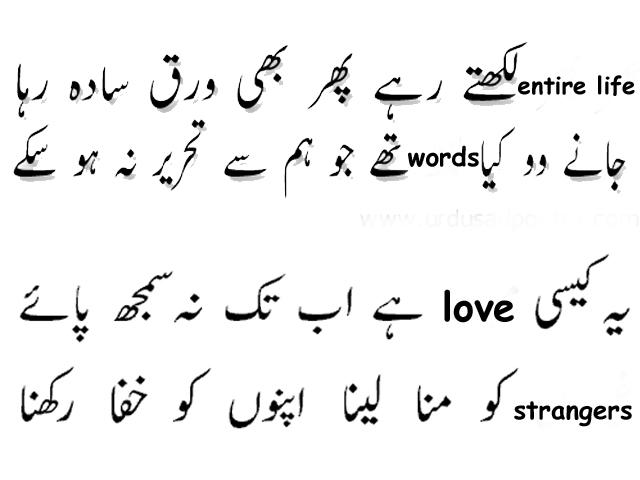
“Humne Urdu k saath sautanon wala sulook kara hai aur almiya ye k ye samjhanay k liye bhi aik dusri zubaan ka sahara lena parega.”
(We have always treated Urdu as a step-child and the worst part is, in order to fully understand our native language, we seek help from a foreign one.)
It hits hard, doesn’t it?
Sadly, what we never realise is that language is an art that breathes with those who breathe it. It matters not which language you speak, neither does is matter what your prowess is in the language, but what does matter is the respect any and all languages command. If the respect is lost then eventually so will the language.
“Mujhay dard ho RAHI hai”, is a classic example of many of the sentences I have grown up listening to from friends who proudly state that their Urdu language skills are poor but are the grammar police when it comes to English. I am myself guilty of the latter. However, I am trying to get rid of this habit.
Yes, English is an international language and should be spoken properly. But that is the case for every other language. Why has it become so acceptable to not know Urdu well?
Years ago, when my late grandfather said to me, “Naimat khanay mai rakha hai”, I did not know what ‘naimat khana’ was and I believed it was not such a big deal to not know. But years later, I wish I had put more effort in learning my own language. I wish more people had corrected my Urdu and pushed me towards improving it.
However, unfortunately, I belong to a generation which was taught that communicating in English adds more value and credibility to one’s discourse. I was made to believe that conversing in English reflects that I am well-educated and cultured.
Moreover, it did not just matter if I spoke English, but it also mattered how well I spoke it, that is, how well I could impersonate the accent of the native speakers.
It took me many years of education to realise how I was still under the influence of my ancestors’ colonial masters.
In 2014, while attending a summer school in The Hague, a Columbian friend commented that from my accent she could not tell where I am from because I sounded mostly American and sometimes British.
Back in Pakistan, and during my teenage years, when I was trying to learn how to converse in English, I would have taken this as a compliment. However, this time I felt sad. I was surrounded with people who spoke English with beautiful Arabic, Italian, French and Spanish intonations and I could instantly tell where they were from. But my nationality was always a question mark for most.
Ever since I came to the Netherlands for my Masters, I have been surrounded by people from all nation states of the European Union. Many of them struggle with English during classes. I feel so much more at ease speaking English with and in front of them than I did at my university in Karachi, because here nobody judges or makes fun of people if they mispronounce a word or make a grammatical error. They do not think that mastery over the English language defines them. In fact, in a friend’s Economics class, a student read (with all honesty) the sentence ‘Niger cannot pay its debts’ as ‘Nigger cannot pay its debts’ and everyone more or less managed to keep a straight face. Back home, this would have been equivalent to social suicide.
Even my Dutch, Greek and Belgian teachers struggle with speaking in English at times and sometimes they cannot find the right word in English for a word from their language and they turn to the students for assistance. Back home, I remember we often evaluated the teachers not on their teaching skills but on how well they spoke English.
Europeans have taught me to take pride in my language. They (minus those from the United Kingdom) completely own up to the fact that English is not their native language and they feel no shame in struggling with it. My Italian and Spanish housemates often tell me that they feel I am a native speaker of the English language. And the only person who tries to correct my haywire sentences when I am speaking, is an Indian friend, who is a PhD student and I guess suffers from Stockholm syndrome like many of us do, back home, thanks to colonisation.
Living in a foreign country has also made me appreciate Urdu. Before, I never paid much attention to its beauty and the comfort which it provides. Now I anticipate speaking in Urdu after a long day of speaking in English. I jump at the opportunity to have a conversation in Urdu when I am with an Indian or a Pakistani.
When my European friends hear me conversing in Urdu, they often comment on how beautiful the language sounds. Two of my Indian friends have confessed to me that they find Urdu more eloquent than Hindi. I quote Ghalib, Iqbal and Faiz with pride to Indian friends who appreciate poetry and in return they recite Javed Akhtar’s poetry from Zindagi Na Milegi Dobara. It is a shame that I always took Urdu for granted and it took traveling thousands of miles away from home to stop doing that.
I do not know how, when and why the mentality that Urdu is a lesser language and it is all right to not know it well seeped through our people. I have heard people suggest that we should do away with Urdu altogether and should make English the national language. Their argument is that Urdu serves no purpose and is not widely spoken around the world. As a reply to them, I often quote the example of the Dutch language. It is spoken in the Netherlands, a tiny country on the world map and in Belgium. A total of 28 million people speak it and yet in the Netherlands the Dutch take pride in speaking Dutch as much as possible. It is the official language and most business is conducted in Dutch unless it involves people who do not speak Dutch.
Urdu has over 70 million native speakers, so I do not understand why people claim that it is a useless language. No language is useless unless the speakers of that language decide to abandon it. People add importance to the language by speaking it, promoting it and taking pride in it.
On International Mother Language Day let’s aim to take pride in our mother languages be it Urdu, Sindhi, Punjabi, Pushto, Balochi, Saraiki, Hindko, Farsi, Shina, Khowar, Darri, Gujrati, Memoni, Torwali, Brahui, Marwari.
P.S: The first sentence has a mistake in it. That was our litmus test. Did you pass?
The views expressed by the writer and the reader comments do not necassarily reflect the views and policies of the Express Tribune.
Such meaningless debates keep filling space in India also regarding Hindi and Sanskrit. People learn to earn and not to be aalim aur pandit. However about Urdu a very notable point is that it is not the language of any of the provinces of Pakistan.
Still you people call it Pakistani language at your whims.
Urdu is as foreign a language to Pakistanis as English. The native languages are Punjabi, Pashto, Darri, Hindko etc. Urdu/ Hindi were imposed on to Pakistanis.
exactly! thank you!
Because every nation needs a common language and Urdu was the only language which was understood and could be easily adopted in every part of country.
For me Urdu is not a foreign language. My mother tongue is Urdu, because my ancestors migrated from India. My family has been speaking Urdu for generations and we have no link with regional languages.
I think same is the case with the author. If her mother tongue is Urdu then I guess she has every right to talk about it. Because it would not make sense for her to talk about Punjabi or Sindhi if she does not speak it.
What I got from this article was that – respect and promote your native language. Simple as that. Why make things complicated by starting a debate about Urdu’s status? She is not saying that Urdu should take over all regional languages or it is superior n any way.
Hum be love mein kamal kartay hain
I love you likh kar send to all kartay hain
It’d be worth it if your English was good. Unfortunately, it’s not.
It woukd be worth if your manner was good. Unfortunately it is not .
Author would do well to learn and accept the fact that Urdu is an Indian language. Originated in Uttar pradesh.
Urdu is an Indian language? Using your Indian logic, Sikhism is a Pakistani religion – its birth land is in Pakistan.
My mother tongue is Urdu, because my ancestors migrated from India. My family has been speaking Urdu for generations and we have no link with regional languages.
I think same is the case with the author. If her mother tongue is Urdu then I guess she has every right to talk about it. Because it would not make sense for her to talk about Punjabi or Sindhi if she does not speak it.
What I got from this article was that – respect and promote your native language. Simple as that.
Urdu is not a foreign language in Pakistan. Only people with a closed mind would say so. If one were to stick with the logic of Urdu being a foreign language, than the true native language of the human race would be a form of sign language punctuated with some exclamations.
Do substitute kara with kiya in the first sentence.
Urdu Language was a mixture of multiple regional languages from the day one of its inception was basically a communication link among the various nationalities and vastly spoken and understood throughout Sub-Continent, Gulf and in the Middle East. This language is a beautiful mixture of Sin skirt, Farsi, Arabic, and of Sindhi, Pashto, Baluchi and on top of Panjabi; Let’s not polities Urdu for peaty mindset because this is the language of Ghalib, Iqbal Faiz……………………..
one of the best articles regarding our complex to fit in the English world out there
Error. ‘Sautanon’ does not imply step child….’sautelon’ does. Mind you I had my education at a convent school in Karachi, following the University of Cambridge for syllabus.
I wish though educated Pakistani people feel more pride in the fact that they do not have to struggle to communicate flawlessly in English when they reside abroad or compete for jobs, or advanced training academically in the developing world or even locally when working for any dynamic local or multi national organisation in Pakistan.
Living in the Western world, I often see how painfully hard it is for people who have immigrated from Iran, China, Arab countries to understand or communicate as well in English as most of our Pakistani immigrants do. Simply because in Pakistan in most good schools we are taught English as a language of communication rather than as a foreign language. Plus being a post colonial society most of our urban culture remains influenced by English. Which surely gives us a competitive edge on the global stage.
No doubt Urdu is a beautiful language and Urdu Literature should be taught in schools as a subject but no harm in giving a little bit of priority to a Universal languagelike English, if we are to remain engaged in the fast paced international world. In fact my suggestion would be that schools in Pakistan should also offer Spanish as an additional language to learn in their curriculum.
“P.S: The first sentence has a mistake in it. That was our litmus test. Did you pass?” – The error was intentional. I picked it too, glad you did too!
And I agree with you, more languages should be taught in Pakistan. Urdu is similar to Arabic and Persian so those two can be good starting points.
French is a good option for those interested in literature. Learning German opens up so many options to study for free at German universities.
All these fancy private schools (since they can afford to) should teach children from a young age at least one foreign and one regional language.
Besides those 70 million “Urdu” speakers, there are all the second language speakers as well as all the “Hindi” speakers who can perfectly understand. By many estimates Hindustani (Hindi-Urdu) is now the second most spoken language in the world after Mandarin and ahead of English and Spanish.
e
However, unfortunately, I belong to a generation which was taught that
communicating in English adds more value and credibility to one’s
discourse. I was made to believe that conversing in English reflects
that I am well-educated and cultured.
.
The author generation was given the colonial gag but had all the time to learn since! Through language one communicates and to acquire the knowledge. The english language is a germanic language with a limited vocabulary and has therefore been given the status of lingua franca because of large number of people speaking it in the anglo saxon countries and their former colonies. Those who have interest in philosophy need to learn french and german in addition to their mother tongue ( Mr Iqbal is the example) and those who do clinical research in science cannot avoid the working knowledge of english since the American universities receive a very large private contributions for research projectslam( Mr Salam is the example).
The author has not explained the motivation factor for urdu learning, especially for those having a different mother tongue?
Rex Minor
Why surprised, Pakistan has made it more acceptable to believe they are like Arabs rather than relating themselves to Indian sub-continent. It is a mis directed and confused priority of self identity.
Why should Pakistanis relate themselves to Indians? For that matter, why should anyone in the right mind relate themselves to Indians? Pakistani culture and Indian culture are two different cultures. Any similarities are due to Muslim rule for almost 1000 years. Pakistanis can easily fit in Saudi Arabia or Iran due to their culture whereas an Indian would never fit in Saudi Arabia and Iran also because of their culture.
why do you learn a foreign language like English?
She is not saying everyone should learn Urdu. From what I can gather, she just wants people to hold on to their native languages and not think of them as inferior. Her native language is Urdu so she is spoke about Urdu.
The mistake in the first sentence is sautanon. It should have been sautelon. That’s the test, right? I hoped I passed.
Isn’t this article more of a subjective account, rather than an fact based write-up on Urdu,it’s superiority and why everyone should know it?
There are many motivation factors to learn Urdu, for example, Urdu prose and poetry. But that is not the point here. She does not seem to advocate for people to learn Urdu.
I think she just wants to put the message forward that whatever your mother tongue is – cherish it. Her mother tongue is Urdu so she is talking about Urdu.
Very well written article by Amna Mohsin. Pakistan is the only country in the world where Urdu is taught & spoken in all its pureness and the Pakistani should not loose this identity only because English is an International language. Who knows English in Russia, China Germany, France etc…So lets be proud of our own language Urdu and maintain it because tomorrow you don’t expect a foreign country to protect and spread Urdu language. Look at Arabic countries how they are preserving Arabic language in all their studies and communication without caring for English.